Celebrate 20 years of the TLR-1

Archive for the ‘C-UAS’ Category

2026 Canadian National Counter UAS Conference

Friday, February 13th, 2026

March 2nd and 3rd, 2026, please join the Kingston Police, Ottawa Police, and the Correctional Service of Canada for the 2026 Canadian National Counter Unmanned Aircraft System Conference at the Westin Ottawa, 11 Colonel By Drive, Ottawa ON. Conference topics include Organized Crime use of UAS for trafficking, Contraband into prisons, Narcotics and Firearms across national borders, Narcotics and Firearms within cities, protecting major events and mass gatherings from UAS attacks and miss-use, VIP protection, Protecting public infrastructure from drone attacks (power plants/lines, public safety & government buildings), weaponized UAS use in terrorist and national security related attacks, update on UAS use in Ukraine and future domestic trends, and A panel discussion on needed legislative changes to support enforcement and investigations. Please use links in attached flyers to register or go to Reservation-Link for hotel reservation and 2026 National Counter UAS Conference Tickets, Mon, Mar 2, 2026 at 8:00 AM | Eventbrite to register for the event.

Event registration is $335.00 CAD, and lodging is available for $229.00 CAD per night at the Westin.

DroneShield Appoints Michael Powell as COO to Support Global Expansion and Operational Scale

Wednesday, February 11th, 2026

10 February 2026 – DroneShield (ASX:DRO), a global leader in counter-UAS technology, today announced the appointment of Michael Powell as Chief Operating Officer, reinforcing the company’s operational leadership as it enters its next phase of global growth.

The appointment follows a period of accelerated expansion for DroneShield, including increased activity across Europe and the United States, rising demand from defense, government, and critical-infrastructure customers, and a major expansion of manufacturing capacity at the company’s Alexandria, New South Wales facility. The expanded site significantly increases production throughput, shortens delivery timelines, and strengthens supply-chain resilience, positioning DroneShield to support long-term programs of record and sustained global demand.

Michael brings more than 25 years of senior executive and operational leadership experience across defense, aerospace, secure communications, simulation, railway and critical infrastructure markets. His career includes senior roles such as Chief Operating Officer, Managing Director, and Operations Director at leading international organizations including Thales Australia and Knorr-Bremse, where he led large, multinational teams and managed complex, multi-hundred-million-dollar operational portfolios.

Image: Michael Powell, Chief Operating Officer, DroneShield

Across these roles, Michael has built and scaled global manufacturing and supply-chain operations, led international business turnarounds, and delivered large-scale operational transformation programs, balancing execution discipline with the demands of high-reliability, mission-critical customers.

As Chief Operating Officer, Michael will be responsible for scaling DroneShield’s global operations, strengthening delivery and sustainment capability, and aligning engineering, manufacturing, and supply-chain functions to support the company’s expanding product portfolio and growing international customer base. His appointment reflects DroneShield’s focus on operational excellence as counter-UAS capability becomes embedded within national security, public safety, and critical-infrastructure protection frameworks worldwide.

“Michael is a proven operator with deep experience delivering complex programs at global scale,” said Oleg Vornik, Chief Executive of DroneShield. “As demand for counter-UAS capability continues to accelerate, his leadership will be instrumental in ensuring DroneShield scales with discipline, resilience, and a relentless focus on customer outcomes.”

Michael has lived and worked across Australia, Asia-Pacific, United States, Europe, and the Middle East. He holds a Master of Business Administration, a Bachelor of Engineering and is a Chartered Professional Engineer, and is a Fellow of the Institute of Engineers.

Grand Forks AFB Selected to Lead Point Defense Battle Lab

Sunday, February 1st, 2026

GRAND FORKS AIR FORCE BASE, N.D. —  

In October 2025, the 319th Reconnaissance Wing assigned to Grand Forks Air Force Base was selected to lead the Point Defense Battle Lab, supported by the 184th Wing, Kansas Air National Guard. The Total Force team at the battle lab supports Air Combat Command’s Point Defense Task Force, a larger Counter Small Unmanned Aircraft System (C-sUAS) effort within the Department of the Air Force.

The Point Defense Battle Lab will serve as a hub for collaboration, pushing boundaries in C-sUAS capabilities, ensuring the Air Force maintains tactical superiority against evolving threats, and is a key part of the service’s effort to develop and evaluate advanced technologies to defend installations from sUAS threats.

“The 319th Reconnaissance Wing is honored to lead the Point Defense Battle Lab alongside our Air National Guard partners,” said Col. Alfred Rosales, 319th RW commander. “Total Force integration enhances our ability to field emerging technologies and match our capabilities to the threat environment. The men and women of the 319th RW have extensive knowledge with unmanned, remotely piloted technology and will ensure our force is poised to secure our installations and defend the homeland.”

The PDBL is a critical initiative within the Department of the Air Force, designed to safeguard installations, protect vital assets, and ensure continuity of air operations. Specifically, the PDBL will focus on developing and validating tactics, techniques, and procedures for countering a wide range of airborne threats, including small Unmanned Aircraft Systems. The Battle Lab’s efforts will enhance the Air Force’s ability to detect, track, and neutralize these airborne threats effectively.

ACC selected the 184th Wing, in partnership with the 319th Reconnaissance Wing, based on combined current capabilities, missions, industry and academia partnerships and alignment with counter-small UAS fielding timelines. The 184th Wing was specifically selected for its expertise in air battle management, cyber operations, and AI-enabled intelligence, surveillance, and reconnaissance. The 134th Air Control Squadron’s continued efforts with the Air Base Air Defense System-Missile Defense, which has already positioned the 184th Wing as a leader in airbase defense, will also be contributing to the efforts of the Battle Lab.

“This is a significant opportunity for the 184th Wing to leverage our expertise and contribute to a critical national security mission,” said Col. Joe Deeds, commander of the 184th Wing. “Our Air Battle Managers, cyber warriors, ISR operators, and AI specialists are ready to work alongside the 319th Reconnaissance Wing to ensure the success of the Point Defense Battle Lab and to enhance the security of Air Force installations.”

The Point Defense Battle Lab (PDBL) will drive innovation and collaboration across the Total Force to address the growing challenges from increasingly widespread use of small Unmanned Aircraft Systems (sUAS). By integrating the expertise of the 319th Reconnaissance Wing and the 184th Wing, the PDBL will deliver critical tactical-level data, advanced site design concepts, and cutting-edge integration strategies for emerging technologies. Additionally, the lab will spearhead operational experiments and red teaming initiatives, ensuring the Air Force remains agile and prepared to counter evolving threats. Through its efforts, the PDBL strengthens the Point Defense Task Force’s ability to safeguard airpower, maintain combat readiness, and confidently respond to emerging challenges, further securing Air Force installations and operations.

By MSgt BreeAnn Sachs

319th Reconnaissance Wing Public Affairs

Metis Launches Skyperion Lightweight – Mobile C-UAS Detect, Track and Identify

Thursday, January 29th, 2026

Metis, specialists in providing Radio Frequency (RF) and drone detection innovative technologies across diverse sectors, launches their latest detection product, Skyperion Lightweight. Skyperion Lightweight has virtually all the same passive counter-uncrewed air systems (C-UAS) detect, track and identify (DTI) sensor capability as its operationally proven and highly respected big brother Skyperion Rugged, but has been re-engineered into a smaller weight and power (SWaP) format optimised for users requiring mobility, rapid deployment and on-the-move operation.

For the last 10 years, Metis has been at the forefront of passive C-UAS RF detection capability development, with Skyperion Rugged being the RF DTI capability integrated into the RAF’s ORCUS system and Leonardo’s Falcon Shield deployed with NATO allies, helping to safeguard their airspace, key installations and critical infrastructure against the threats posed by rogue drones. The Skyperion product range captures RF emissions of varying strengths across the spectrum, filtering out background noise and known entities, before rapidly analysing them to identify and locate potential threats.

Skyperion products, already at Technical Readiness Level (TRL) 9 and operationally proven with multiple NATO partners, are distinguished by a non-library-based Open ESM waveform analysis. This approach identifies both cooperative and non-cooperative emitters across a wide spectrum of frequencies, providing an agile, comprehensive RF detection capability without reliance on static signal libraries. Skyperion is also the ideal choice to be integrated into a wider range of counter- drone capabilities (radar, optics, jamming and defeat) because it has been designed and manufactured to be system agnostic, modular and with an open architecture. This allows sovereign nations, large primes or system integrators to easily incorporate Metis products with other best-in-class technologies, to deliver world-leading detection, tracking, identification and defeat of rogue drones.

Tony Burnell, CEO of Metis said: “With the increasing proliferation of rogue drones being used for nefarious means, it is essential that we continue to innovate and develop new products to counter these threats. Skyperion Lightweight offers users ultimate flexibility on how it is deployed – not only protecting fixed locations but also providing virtually the same level of protection as Skyperion Rugged in a mobile format which we know many potential customers are seeking.”

DroneShield Releases Q1 2026 Software Updates

Wednesday, January 21st, 2026

21 January 2026 – DroneShield, a global leader in counter-drone technology, today announced the release of its Q1 2026 software updates notably across the DroneSentry-C2, DroneSentry-C2 Enterprise, and RfPatrol-Plugin, alongside firmware updates for detection and disruption devices

The Q1 2026 release is designed to simplify operations, reduce cognitive load, and help operators make faster, more confident decisions when managing drone threats across military, public safety, and critical infrastructure environments.

A key focus of this update is improved system interoperability and sensor coordination of DroneShield’s DroneSentryecosystem. Expanded multi-sensor support and enhancements to SensorFusion improve detection accuracy and tracking reliability, including for mobile and on-the-move deployments. These changes help operators maintain clearer situational awareness in complex and cluttered airspace. 

The RfPatrol-Plugin received a significant upgrade, enabling drone detection and tracking data to be shared across TAK networks when connected to DroneShield systems. Operators can now view additional contextual information, including historic movement paths, supporting better coordination and faster response.

For organizations operating multiple protected sites, DroneSentry-C2 Enterprise now enables more active command-level control. In addition to monitoring, authorized operators can manually control disruptor engagement and camera pan-tilt-zoom functions at individual sites, improving visibility and reducing response times during time-critical incidents.

Disruption workflows have also been refined to support more controlled and proportional responses. Operators can target specific detected drones, while clearer, icon-based system status indicators provide immediate visibility into disruptor state, allowing operators to act quickly and decisively.

DroneSentry-C2 performance and usability have been further enhanced through updates to mapping and interface workflows. Improvements include reduced latency, smoother interaction, simplified controls, and clearer visual cues, all aimed at supporting faster interpretation and lower operator workload during live operations.

Together, these Q1 2026 updates reinforce DroneShield’s focus on operational clarity, reliability, and real-world usability – ensuring operators are equipped to respond with confidence as drone threats continue to evolve.

Joint Interagency Task Force Announces First Replicator 2 Purchase to Counter Homeland Drone Threats

Friday, January 16th, 2026

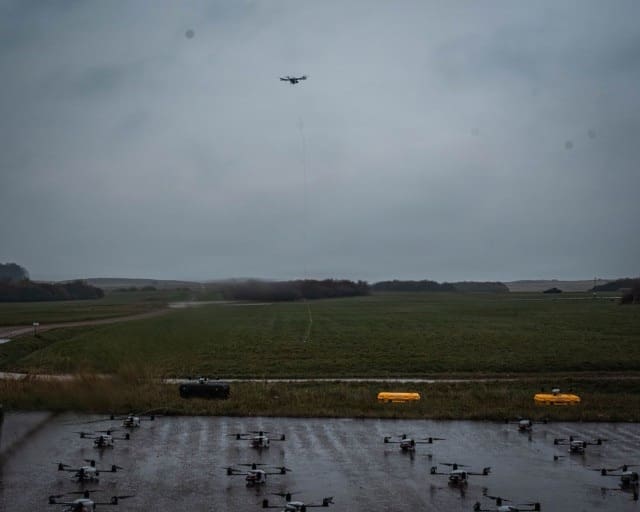
WASHINGTON — Joint Interagency Task Force 401 announced Jan. 11 its first acquisition under the Replicator 2 initiative, awarding a contract for two advanced DroneHunter F700 systems, which are expected to be delivered by April.

This acquisition provides the task force with enhanced capabilities to counter the growing threat posed by small unmanned aerial systems. It also marks a significant step in the War Department’s strategy to rapidly field counter-unmanned aerial systems to protect military installations and critical infrastructure across the United States.

“We’re designed to move at the speed of relevance, cutting through red tape, consolidating resources, and engaging venture capitalists, tech startups, and nontraditional defense firms as critical partners,” said Army Brig. Gen. Matt Ross, JIATF 401 director.

“We have just one measure of effectiveness: to deliver state-of-the-art counter-UAS capabilities to our warfighters both at home and abroad. This purchase of the DroneHunter system is a key first step in accomplishing our Replicator 2 mission,” Ross added.

Replicator 2: A New Approach to Counter-UAS

The Replicator initiative, first announced in August 2023, is a War Department effort to accelerate the delivery of innovative capabilities to the warfighter at speed and scale.

While the first phase, Replicator 1, was focused on deploying thousands of autonomous systems across multiple domains, Replicator 2 is specifically aimed at countering the threat posed by small UAS.

The joint task force, established in August 2025, is the lead organization for this effort, tasked with synchronizing counter-small UAS efforts across the department and rapidly delivering joint capabilities.

“Replicator 2 is not about starting from scratch,” Ross said. “It’s about leveraging the incredible innovation happening in the commercial sector and getting it deployed where it is needed most.”

The DroneHunter: A State-of-the-Art Solution

The DroneHunter is a reusable, artificial intelligence-driven interceptor drone that provides a unique and effective solution to counter small UAS, especially in settings where personnel, infrastructure and surrounding activity require careful control of effects.

The system uses AI and radar to detect and track small, low-altitude drones in complex environments. Once it spots a potential threat, the system can capture it with a tethered net.

The captured drone is then safely towed to a designated location for forensic analysis. This solution is ideal for use in the homeland, where the risk to civilian populations and infrastructure must be minimized.

This initial purchase is the first step in the tailored approach the task force will take to deliver state-of-the-art counter-UAS technology to protect military infrastructure and service members.

“This is one example that demonstrates how JIATF 401 has taken counter-drone efforts from a community of interest to a community of action,” Ross said. “The task force is focused on a whole-of-government approach, working with interagency partners and industry to build a layered defense against the full spectrum of small UAS threats to the homeland.”

By Lt. Col. Adam Scher, Joint Interagency Task Force 401

US Army Enhances C-UAS Data Flow and Interoperability During Project Flytrap 4.5

Wednesday, January 14th, 2026

ABERDEEN PROVING GROUND, Md. — When Soldiers took to the field for Project Flytrap 4.5, they were not only testing emerging counter-unmanned aerial system technology but also tackling a challenge facing multinational operations: how to move sensor data quickly, reliably and securely across networks.

Project Flytrap is a recurring C-UAS experimentation series in Europe focused on assessing passive and active sensors, and defeat capabilities against group 1-3 UAS in a coalition environment. Conducted by V Corps alongside U.S. and partner nation forces, the exercise series is designed to identify capability gaps, test new technologies and refine tactics under realistic operational conditions.

As part of the exercise, Army teams worked alongside V Corps to evaluate how the integrated sensor architecture, or ISA, could help address data sharing and interoperability gaps revealed during earlier iterations of the exercise.

Developed by Capability Program Executive – Intelligence, Electronic Warfare and Sensors, ISA is a framework that connects sensors and networks across domains, services and coalition partners using standardized, open-architecture data formats. As demand for rapid, interoperable sensor data grows across Europe, ISA has emerged as a scalable, plug and play backbone for operations.

“The goal is a plug and play environment where partner nations can bring in their sensors and contribute to a common operating picture,” said Russell Nadler, a technical program integrator with CPE-IEW&S’ Integration Directorate. “ISA can be the enabler that helps pass sensor data seamlessly between allied and U.S. systems.”

Conducted over multiple iterations in recent months across locations in Germany and Poland, Project Flytrap supports the Eastern Flank Deterrence Line warfighting concept by bringing U.S. and partner-nation soldiers together to evaluate new technologies under realistic conditions. Previous iterations exposed limitations in existing networks, particularly when integrating multiple sensors and processing large volumes of data in real time.

“For us, Flytrap really highlighted the importance of having an architecture that could scale and adapt as systems were added,” said Maj. Oniel Rhooms, Project Flytrap network integration lead for V Corps. “By the time we got to 4.5, ISA had matured to a point where it could actually enable that integration instead of becoming another barrier.”

Built for Interoperability

By leveraging open data standards, ISA enables information from radar, optical, infrared and acoustic sensors — regardless of origin — to flow into a shared environment without custom re-coding or system-specific interfaces. This approach provides a more flexible and resilient way to integrate sensors across units and coalition partners.

“ISA wasn’t just part of the network, it was also part of how we validated vendors,” Rhooms said. “It helped us determine early on whether systems could actually connect and deliver what they claimed, which saved time and reduced risk once we went live.”

That flexibility extended beyond technology. Rhooms emphasized the importance of the ISA team’s on-site support, noting their ability to adapt quickly as conditions changed.

“The people mattered just as much as the technology,” he said. “They were able to pivot, solve problems on the spot, and make connections happen that otherwise wouldn’t have.”

Looking ahead

As adversary drone tactics continue to evolve, exercises like Flytrap remain essential for testing technologies under real-world stress. With Flytrap 4.5 demonstrating the value of a more integrated approach, V Corps and CPE-IEW&S will continue refining how ISA supports interoperable C-UAS and sensing operations across the European theater.

By Kay Edwards

Rapidly Developed Counter-Drone Prototype Succeeds at NATO’s Bold Machina

Tuesday, January 6th, 2026

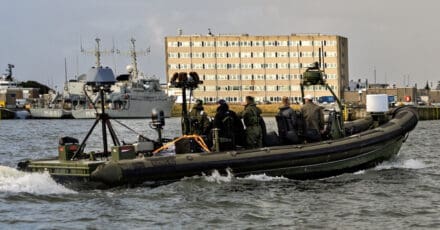
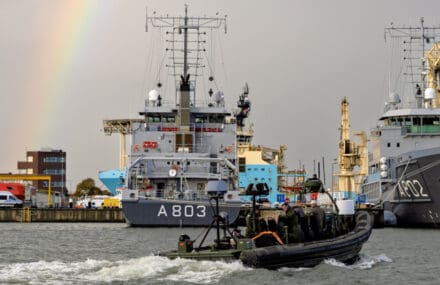
A new, innovative detection system for countering uncrewed aerial systems (c-UAS) conducted its first field tests at sea during the Bold Machina (BOMA) exercise in the Netherlands this September. Rapidly developed by a small team led by officer-scholars from the Naval Postgraduate School (NPS), the c-UAS system deployed aboard a Dutch Navy fast raiding, interception, and special forces craft (FRISC).
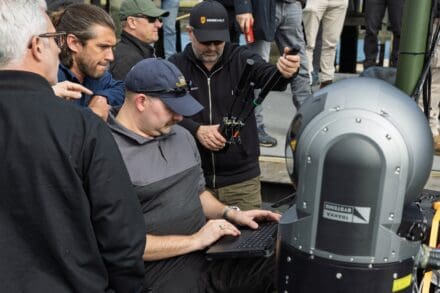
Designed for passive operation, the system employed artificial intelligence (AI) to integrate multiple independent sensor platforms to detect and identify class 1 drones. Because these types of drones are numerous, small, and difficult to track, they pose significant threats. When fully functional, the system provides special forces operating in the maritime domain valuable protection against distant incoming drones without compromising their position.

The NPS efforts support the U.S. Department of War’s priority to accelerate drone development and deployment outlined in “Unleashing U.S. Military Drone Dominance.” The memo laid out the plan for how the department would “… power a technological leapfrog, arming our combat units with a variety of low-cost drones made by America’s world-leading engineers and AI experts.”

Local and International Teamwork

NATO Allied Special Operations Forces Command (SOFCOM) sponsored BOMA with technical support from the NATO Center for Maritime Research and Experimentation (CMRE). Over 150 personnel from 17 individual NATO special operations forces (SOF) commands and two NATO partner SOF commands participated. Representatives from Ukraine also attended. International collaborations like this are essential for ensuring national and global security and maintaining cooperation between allies.

Military conflicts often drive rapid advancement and adoption of new technology. Exemplifying this, the war in Ukraine has thoroughly demonstrated the urgent need to detect hostile drones that continuously evolve in capability. And NPS is helping to harvest these hard-earned lessons.

“For us, it’s a question of survival,” said a special operations forces colonel, who serves in the Armed Forces of Ukraine and is also earning a master’s degree in defense analysis from NPS. “So, we’re more than motivated to create the most efficient and effective weapons and counter-weapons to use against enemies as soon as possible and as cheaply as possible.

“Every time I watch or read the news about a missile attack or drone attack or mixed attack, it’s so hard,” the Ukrainian colonel added.

But all of the Ukrainians understand the vital importance of their advanced education at NPS — to share what they know and what they are learning. It’s a force multiplier and will allow them to make bigger contributions to Ukraine’s defense once they return. “One thought that actually warms and encourages me is this education. Sharing our experiences. Thinking more strategically. It will help me execute my mission much better,” he said.

During the Ukrainian colonel’s studies, he joined over 80 other NPS officer-scholars — from the U.S. and across the globe — and faculty from the defense analysis and information sciences departments to observe NPS’ Joint Interagency Field Experimentation (JIFX) exercise held in August. It’s here where he encountered the BOMA team from NPS testing their c-UAS system in collaboration with other experimenters and industry partners. He and his countrymen had insight to share.

Former NPS provost Scott Gartner is now a professor teaching for the NPS Department of Defense Analysis. He was responsible for organizing the large student and faculty group visit to JIFX because he understands its importance.

“JIFX captures what’s really special about NPS. It’s a collaboration of students, faculty, military, industry, government, and leaders from all over — just like NPS,” said Gartner. “I think that kind of collaboration is critical. It’s applied and working to accomplish important advances, which is demonstrated by JIFX’s focus on innovation. It’s the secret sauce of NPS.”

Bold Machina Design Challenge

SOF combatant craft, such as FRISCs and other rigid-hull inflatable boats (RHIBs), on open water can be at high risk of drone attack because they’re exposed without cover. NATO SOFCOM identified this vulnerability as the focus of their design challenge for the 2025 BOMA exercise.

Back in January, as two NPS officer-scholars worked toward their graduate degrees, they faced the seemingly impossible while enrolled in a special directed study course that covered this BOMA design challenge.

The course was a 90-day sprint study that tasked them “to understand the unique c-UAS challenges posed to maritime SOF combatant craft and propose next steps to close an existing capability gap.”

U.S. Navy Lt. Cmdr. Max Leutermann, an engineering duty officer studying system engineering, and Swedish Armed Forces Maj. Patrik Liljegard, a special forces officer studying defense analysis, eagerly accepted the challenge. They brought over 35 years of military service together, and their multidisciplinary experience proved invaluable to finding a solution.

“The ability for NPS to bring together defense subject matter experts, industry partners, and operationally experienced officer-scholars was recognized by NATO Allied SOFCOM as a unique opportunity to develop innovative solutions to a real-world problem,” said Kevin Smith, the lead and principal investigator for the BOMA effort at NPS. “This partnership not only advanced warfighting capability, but also greatly enriched the educational experience of all of the students involved.”

Liljegard and Smith presented the proposal to NATO Allied SOFCOM in Poland last April, where it was approved and additional funding for them to build a prototype was provided. But they still needed a lot of help to turn their proposed solution into reality. So, by forming partnerships across industry, they found the resources and expertise able to assist them.

“NATO required us to create a system that was passive so that operators who were on a small boat wouldn’t give off any sort of detectable signatures or emissions,” said Leutermann, who served as a submariner for years. “We spent the beginning of the year figuring out solutions. Now, we started figuring out how to build it and who to build it with.”

Testing Counter-UAV Prototype at JIFX

Temperatures in August frequently climbed to over 100 degrees at NPS’ JIFX, which is held quarterly in southern Monterey County at Camp Roberts. The scorching, dry, and dusty inland terrain did not exactly mimic the conditions likely faced during a SOF mission aboard a FRISC silently cruising along the coast of northern Europe. Instead, the harshness at JIFX in summertime provided benefits in other ways.
It was this environment that enabled the c-UAS team to shake out their prototype while navigating unexpected challenges as they pushed the system beyond its limits. They needed to complete this rigorous testing in time for BOMA.

“We had a very tight timeline,” said Leutermann. But he and Liljegard had been thinking ahead. They attended the JIFX exercises earlier in February and May as observers to learn how to best take advantage of the August exercise.

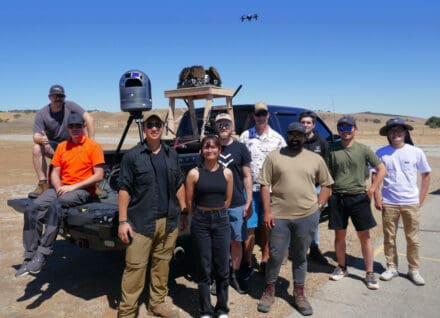
“After we built a mockup, we took it to JIFX to test and prove its functionality. Our goal was to detect drones. Eventually, the system will go on a RHIB for BOMA. But we first strapped the system into the back of my pickup truck and used it like a land boat.”

Their c-UAS system tied together four subsystems: — Multiple independent sensor platforms, which are customizable to the requirements and resources of the operators. — The Tactical Hybrid Operational Router (THOR), which provide the power and network to the hardware. — The Operational Data Integration Node (ODIN), which is an AI-driven, sensor fusion engine. — The navigation display, which overlays the drone detection data from the sensors on the graphical user interface for the operators.

“While companies and other NPS students at JIFX flew their drones all around, we tried to detect them,” Leutermann continued. “Different types of drones at different altitudes, distances, directions, angles of attack, and all of that. Our second goal at JIFX was processing what we detected and representing it on the navigation display.”

The sensor platforms used by the system included: short-range acoustic and electro-optical/infrared (EO/IR) from Mara; direction-finding radio frequency (RF) from DroneShield; broad-spectrum RF from Silvus Technologies; long-range EO/IR from Trakka Systems; and low probability of intercept/detection radar from DspNor.

To counter evolving drone design and adversary tactics, AI from an Nvidia Jetson developer kit drives the c-UAS system by fusing the multi-sensor data, refining real-time UAS detection models, and updating threat libraries. The operators receive the output on a SeaCross navigation display, giving them the detected drone’s bearing, range, altitude, orientation, and identification.

Their system combined sensors and hardware from seven different companies in Australia, Norway, Sweden, and the U.S. Together, these industrial partners provided the sensing, compute, and interface capability the team needed to succeed.

Not all the system’s sensor platforms were in place or ready for evaluation during JIFX, and building of the THOR and ODIN subsystems was ongoing. However, there was still much to learn, and the team spent the days at JIFX driving around the base in their “land boat” detecting drones.
Mounted on a mast attached to the pickup bed of the “land boat,” the Mara sensor platform caught the attention of the NPS students from Ukraine.

Mara’s CTO and co-founder Sriram Raghu explained, “They had great questions, like can our system detect against low altitude flights? What about resilience against fiberoptic drones? What kind of sensors are we using to do different kinds of detection? These questions were helpful to hear from them because they were very aware of the limitations of the different sensors.

“Our system uses a combination of sensors because the behavior of individual sensor types can vary under certain conditions. For instance, on a really hot, sunny day like today, drones light up against the sky on a thermal camera. But against the ground they don’t. Similar things happen with microphone signatures. If drones fly at certain speeds and their motors spin certain ways, they can trick the microphones. So, lots of good insight from them.”

Also attending JIFX were other teams from NPS conducting electronic warfare (EW) studies and operating drones. Like pilots who fly crewed aircraft, certified remote drone operators must stay in practice by flying regularly. So, JIFX provides an outstanding opportunity for them to keep current with flight hours by not only flying drones for their field tests but also assisting in-need experimenters who don’t have their own drones and operators. This collaboration is a very big win-win.

“JIFX not only provides our EW team with the opportunity to perform live RF hardware experimentation in the field, but it allows us to gain valuable ‘stick time’ in order to maintain small-UAS flight proficiency,” said Lt. Cmdr. Calvin Sessions, an electrical and computer engineering Ph.D. student from NPS’ Radar and Electronic Warfare Laboratory and a certified remote drone operator. “In addition to flying for our own investigations, JIFX is an excellent networking event, and we’re happy to collaborate with fellow engineers and researchers.”

“The BOMA team was one of our collaborations that our team worked with going into the event. During JIFX, they told us where to fly as they recorded their data. After the event, we provided their team with the actual flight track data pulled from our system to assist in their analysis. It was a pleasure to give them the support that they needed for their research, and it helped us out, too.”

Leutermann and Liljegard benefitted from working together with others at JIFX as well. Without the exceptionally collaborative environment at JIFX, it would have been impossible for them to fully integrate the hardware and software of their c-UAS system’s multiple sensor platforms.

The intense testing under field conditions that they were able to achieve greatly expanded their understanding of how the system would operate best, which allowed them to better optimize its functionality in preparation to execute during the BOMA exercise.

NATO Special Operations Forces Command’s BOMA 2025

In a matter of months, Leutermann and Liljegard had developed, built, tested, and prepared a prototype of their c-UAS system for sea trials during BOMA by the Dutch Navy from the port city of Den Helder, Netherlands. However, this did not mean the system was complete and fully functional.

“Our system is a system of systems,” said Liljegard, who has made over 10 global deployments with the Försvarsmakten or Swedish Armed Forces. “It was not fully integrated and fully operational before going to BOMA due to the timeline and the unavailability of some of the sensors we planned to use.”

During the first days of BOMA, sensors and equipment were still arriving and had to be connected. The team assembled and integrated hardware and software that they had never used before. But the multinational industry partners that joined them at BOMA stepped up in a big way.

“The great thing is how far we reached in such a short timespan with the NPS team and the industry partners, who all worked together,” added Liljegard. “If one of the companies lacked something, then another company shared its resources. It was fantastic to see everybody work toward the same goal of completing the system.”

Still, having to complete the prototype system while at BOMA was a delay that ate up valuable sea trials time. Once ready, the team deployed aboard a FRISC several kilometers offshore and waited for contacts. Four different types of class 1 drones launched at them—ordinary RF controlled, modified RF controlled, fiberoptic, and autonomous.

“We were able to put all the sensors on the boat, power them up, connect them to the fusion engine, funnel all the detection data through the fusion engine and the database, and then populate it all on the SeaCross display,” Liljegard said of the engagements.

As the FRISC maneuvered, the team watched the drones track on the navigation display in real time. For some drones, Leutermann and Liljegard not only tracked the drones themselves for the entire time in the air but also the drone controllers’ positions. In one case, after the third sighting of a drone not in their UAS library database, the system was able to learn it was a new type of drone, add it to the library, and alert the team that it was a threat.

“In the end, we showcased a system that integrated sensors from multiple companies into one display that operators can use,” said Leutermann. “That capability didn’t exist before. We were able to bring something new to the field.”

Despite the challenges, teammates Leutermann and Liljegard both agreed that the performance of their c-UAS system was very successful and did indeed meet the objectives set by BOMA.

Continuing the Collaboration

NATO says a critical function of the BOMA exercise is to adapt “lessons from ongoing conflicts, transforming today’s battlefield realities into tomorrow’s maritime SOF capabilities.” The collaboration with NPS was so productive that NATO SOFCOM is supporting another 90-day sprint study this winter to explore unique needs in underwater communications, command, and control.

Applying lessons from the war in Ukraine was especially relevant. So, members of the Ukrainian Special Operations Forces participated in the BOMA exercise. While in attendance, they had also visited with the NPS c-UAS team. As Ukrainians also did during JIFX at NPS, they provided insightful feedback to help further advance the development of the system.
The success of the c-UAS system at BOMA could not have been accomplished without the prototype experiments run at NPS’ JIFX exercise in August. For decades, JIFX and its predecessor programs have enabled the rapid development of innovative technology—drones, lasers, AI, additive manufacturing, and much more—vital to meeting national and global security challenges.

“The war in Ukraine has made one point unmistakable: defense innovation must move much faster,” said Aleksandar Matovski, an expert on Russian and European security at NPS’ Institute for Regional and International Security (IRIS).

“New technologies such as the one c-UAS team demonstrated at the BOMA exercise in the Netherlands must be built and fielded at speed to close critical gaps, and existing systems updated almost daily to outpace adversaries who are learning and adjusting rapidly,” Matovski continued. “NPS is uniquely positioned to accelerate these efforts, drawing on its deep academic expertise, officer-scholars with operational experience, strong industry ties, and long-standing programs such as JIFX.”



NPS, located in Monterey, California, provides defense-focused graduate education, including classified studies and interdisciplinary research, to advance the operational effectiveness, technological leadership, and warfighting advantage of the naval service. Established in 1909, NPS offers master’s and doctorate programs to Department of War military and civilians, along with international partners, to deliver transformative solutions and innovative leaders through advanced education and research.

Story by Daniel Linehan
NATO photos by Deacon Westervelt